
What Is Moxibustion? The Japanese Okyu Technique, Explained
Long before anyone reached for a heating pad, there was moxa. Moxibustion is the practice of burning dried mugwort (moxa) at or near acupuncture points, using its slow, penetrating heat to move what needling alone sometimes can’t reach.
At Treehouse, we practice a specific Japanese form of it called Okyu — a technique as old as acupuncture itself, and one we still reach for regularly.
What Is Moxibustion, Exactly?
Our moxibustion uses Artemisia princeps — Japanese mugwort or yomogi — dried, aged, and processed into a soft, fibrous wool. When burned, it releases a steady, penetrating warmth that’s different from a heating pad or hot compress. That heat is directed at specific points on the body, often the same points used in acupuncture, to warm and move stagnant qi and blood.
It’s one of the oldest continuously practiced techniques in East Asian medicine, and it developed its own distinct traditions in Japan, China, and Korea over the centuries.
Okyu — The Japanese Thread-Moxa Method
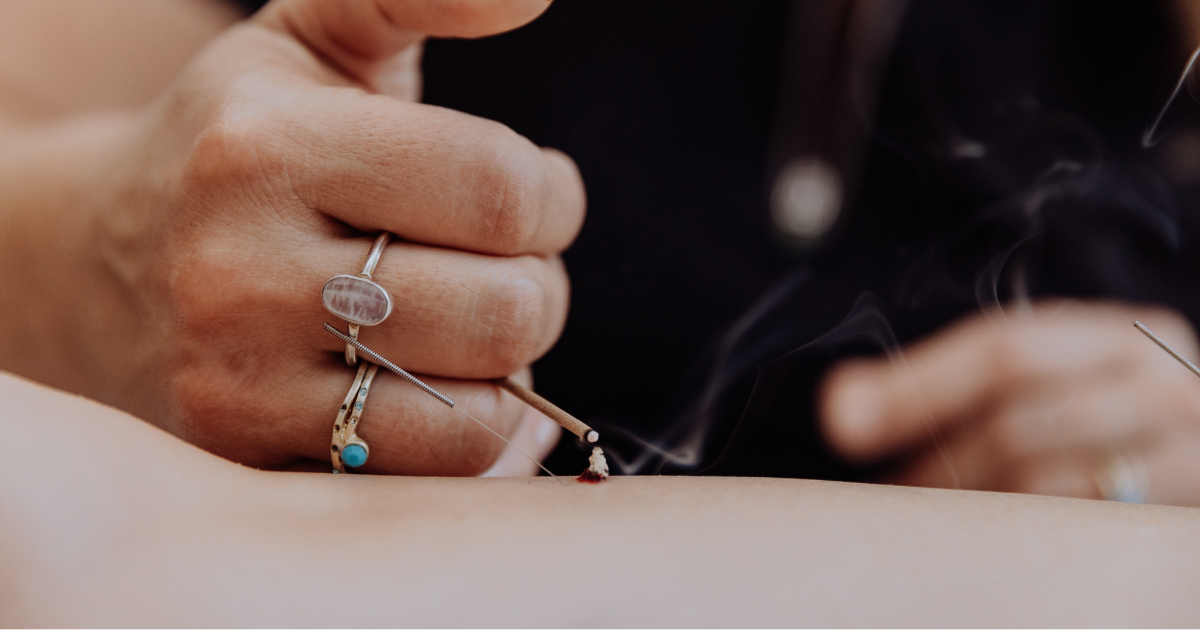
Okyu, sometimes called “thread moxa,” is the traditional Japanese direct-moxibustion technique. Tiny amounts of moxa wool are rolled into thread-thin cones — ranging from string-like to rice-grain sized — and placed directly on the skin at precise points, then lit and allowed to burn down before being removed or extinguished.
It’s a technique that demands precision. The size of the cone, the point selected, and the number of repetitions are all part of the diagnosis — which is exactly why it pairs so naturally with the palpation-based Kiiko Matsumoto style we practice. We’re already reading your body through touch; Okyu becomes another way to respond to what we find.
What Moxibustion Feels Like
Most patients describe it as a pleasant, building warmth rather than a burn — closer to a gentle heat that seems to sink in, rather than sit on the surface. It’s frequently used alongside needling, not as a replacement for it, to reinforce a treatment or to warm an area that palpation shows is cold, tight, or depleted.
Moxibustion has a long research history around pain conditions and circulation, with modern studies continuing to explore its mechanisms — largely centered on its thermal and anti-inflammatory effects. As always, we treat this as one tool among many, chosen because your body’s pattern calls for it, not as a stand-alone guarantee.
Quick Answers
Does moxibustion hurt or burn the skin? Not when performed correctly. Okyu uses tiny, precisely sized cones and is monitored closely — most patients feel warmth, not pain.
What is moxibustion used for? Traditionally, it’s used to warm and move qi and blood in patterns of cold, stagnation, or deficiency — often alongside acupuncture for pain, circulation, and overall balance.
Is moxibustion the same as acupuncture? No — it’s a related but distinct technique. Where acupuncture uses needles, moxibustion uses the heat of burning moxa, often at the same points.
Do you use moxibustion during pregnancy? It’s a technique some patients explore around pregnancy under practitioner guidance — always something we discuss individually, based on your specific situation and timing.
Why We Still Practice It
Moxibustion is easy to overlook in a modern clinic — it takes time, skill, and patience that a heating pad doesn’t require. But it’s part of what makes Japanese-style treatment at Treehouse whole: needling for precision, Hara diagnosis for direction, and moxibustion for the kind of warmth that a needle alone can’t offer.
Curious whether Okyu belongs in your treatment plan? It’s something we assess during your visit at Treehouse Acupuncture, never applied as a default.
Book your session at Treehouse →
Christina M. Casado, L.Ac. is the founder of Treehouse Acupuncture & Wellness, located at 2000 S. Dixie Highway, Suite 205B, Miami, FL 33133. Voted Best of Miami-Dade 2023 and 2025. Questions? Reach us at info@treehouseacupuncture.com or (305) 443-2220.